



 Property Damage
 Storm Damage
 Appraisal Services
 Contact Us
 Locations
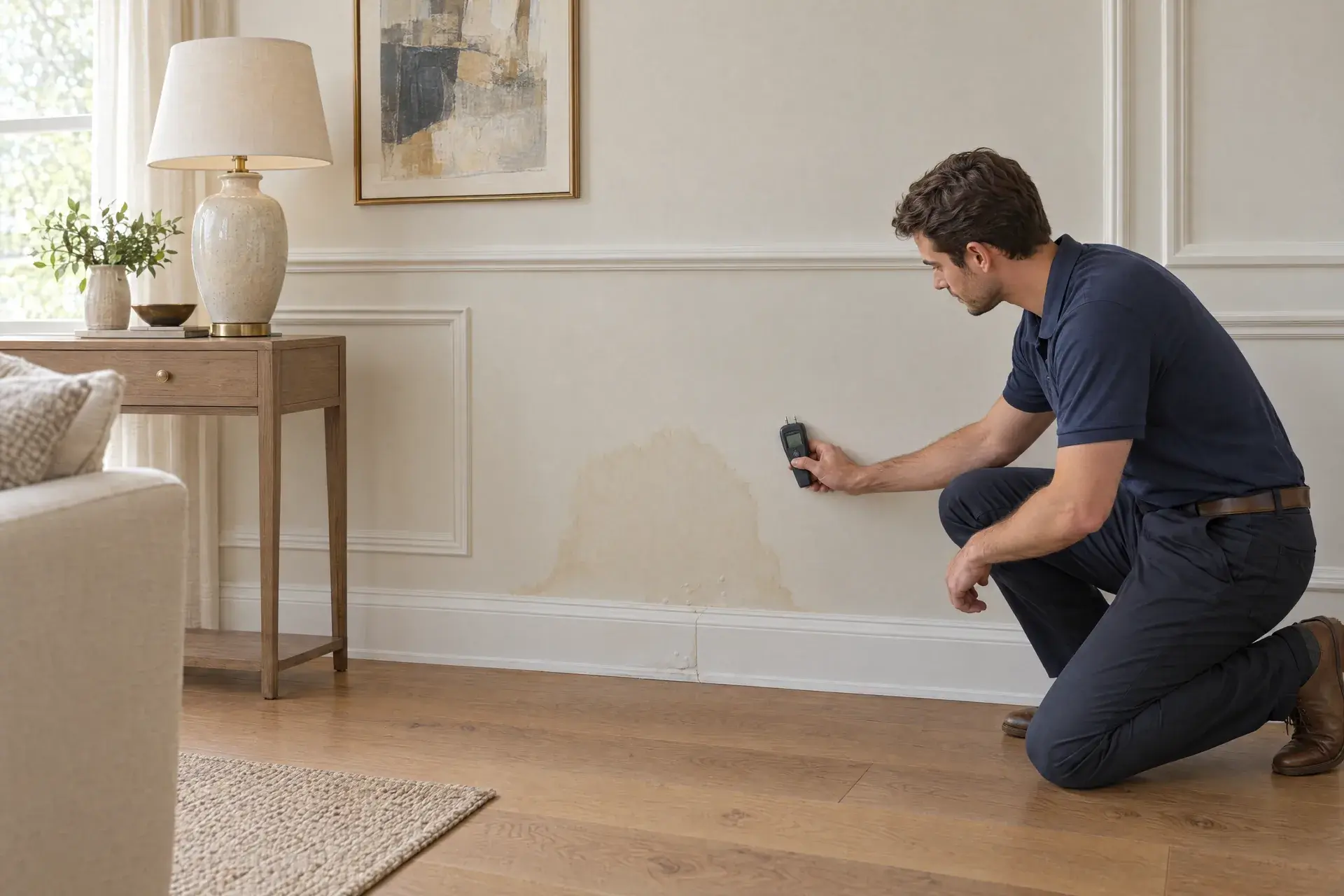

Water behind a wall rarely announces itself with a single dramatic flood. More often it shows up as a stain that grows, paint that bubbles, or a musty smell that will not clear. Catching the signs early helps you limit the damage and push for a claim that covers the full scope — not just the one wet spot the insurance company’s adjuster noticed on a short visit.
Insurance companies often treat wall water damage as a quick paint touch-up, even when moisture has soaked the drywall, insulation, and framing behind it. A licensed public adjuster works only for the property owner, not the insurance company. A public adjuster contests thin estimates, pushes back on delays, and presses the carrier to pay what the policy covers.
Common signs of water in walls
| Sign | What you may notice | Why it matters for your claim |
|---|---|---|
| 1. Discoloration | Yellow/brown stains, tide lines, dark patches | Maps where water traveled — not only where it entered |
| 2. Soft / crumbling drywall | Spongy feel, powdery gypsum, nail pops | Suggests prolonged wetting; scope may exceed paint |
| 3. Peeling / blistering finishes | Paint bubbles, wallpaper lift, warped trim | Finish failure often trails moisture in the cavity |
| 4. Musty odor | Persistent damp smell after HVAC runs | Hidden wet materials; document before heavy cleaning hides clues |
| 5. Floor / baseboard clues | Cupping wood, swollen MDF, rusted fasteners | Water often drops inside the wall then shows at the base |
| 6. Ceiling twin | Stains above the wall line | Points to upper-level or roof/attic source |
| 7. Efflorescence / mineral lines | White powder on masonry | Moisture moving through block/brick |
No single sign settles coverage on its own. Together they show how far the water traveled, and that full scope is what the carrier should be paying for, not just the visible stain.
What to do first (safety + evidence)
- Stop active water if you can do so safely (shutoff, temporary patch) — policies often expect reasonable mitigation.
- Photograph and video before major demolition: wide shots, close-ups, moisture meter readings if a pro takes them.
- Note when you first saw each sign and any recent storms, plumbing work, or appliance failures.
- Keep damaged materials until the carrier has inspected them or your public adjuster says otherwise — tossing evidence early gives the carrier room to dispute the scope.
- Call appropriate emergency help for structural risk, live electrical, or sewage.
For claim-side help after water losses, see UCS water damage and Insurance Claim Help.
Cause categories property owners confuse
Wall moisture can come from:
- Sudden plumbing failures (supply line, drain backup — coverage depends on policy language)
- Weather openings (wind-driven rain through roof, window, or siding failure)
- Slow leaks / seepage (often contested; documentation of timeline matters)
- Condensation / humidity (may be maintenance, not a covered peril)
- Secondary damage after a covered opening (water trails into walls days later)
How the cause is described often decides how the claim is paid. Carriers frequently label wall water as long-term seepage, condensation, or wear and tear to deny or reduce a claim. A licensed public adjuster investigates the source, ties the damage to a covered cause where the facts support it, and challenges a denial or low estimate built on the wrong label.
Mold after water damage in walls
Visible mold or microbial growth can follow unresolved moisture. Health questions belong with medical professionals, and remediation belongs with qualified remediators. On the claim side, mold limits, sublimits, and exclusions vary by policy, and carriers often lean on them to cut what they pay. A licensed public adjuster reviews the policy language, pushes back when mold is excluded or capped without support, and presses the carrier to pay for the covered water damage that caused it.
How a public adjuster fights for your water damage claim
A licensed public adjuster works only for you, the property owner. That means inspecting beyond the obvious stain, tracing interior water trails to the roof, window, or plumbing source, pricing the full repair (drywall, insulation, framing, trim, and finishes), and negotiating directly with the carrier. Thin first offers that price “paint only” while wall cavities stay wet are common, and a public adjuster contests them with a detailed estimate. When the carrier stalls, the public adjuster pushes back on the delay and keeps pressing for payment of what the policy covers. See Why You Should Not Accept an Insurance Company’s First Offer and Top Reasons to Hire a Public Adjuster.
If you are deciding whether to handle the claim on your own, read What Happens When You Don’t Call a Public Adjuster?. To vet a licensed public adjuster near the property, see How Can I Find a Public Adjuster Near Me?.
United Claims Specialists represents property owners in New York, New Jersey, Connecticut, Pennsylvania, Florida, and other states where our adjusters are licensed. Licensing, fee rules, and claim deadlines differ by state, so hire a public adjuster licensed where the damaged property sits and verify the license. For a state example, see When You Need a Public Adjuster in New Jersey.
If you see signs of water damage in your walls, or the carrier has already offered too little or stopped responding, United Claims Specialists offers a free consultation. For nearly two decades, our licensed public adjusters have worked only for property owners, contesting thin estimates and pressing carriers to pay what the policy covers. Start at Insurance Claim Help or call 855-321-5677.
Related: How Do I Reopen an Insurance Claim? · Top 5 Benefits for Hiring a Public Insurance Adjuster



 claims@ucspa.com
 (855) 321-5677
 Mon-Fri: 9:00am-5:00pm